
APSentra, already trusted by more than 130 enterprise clients worldwide, is bringing its source-to-pay technology to US and Canadian organizations — with a straightforward argument: most companies don’t involve procurement until it’s too late, and that mistake is costing them billions.
Here is a number worth sitting with: between $150 billion and $450 billion.
That is the range of savings that McKinsey estimates is available — sitting untapped — in North America’s construction and infrastructure market alone, simply by improving how procurement is managed in large-scale capital projects. The number comes not from inefficiency at the operational level, but from a systemic problem: procurement gets called in too late, too often.
APSentra, a global procurement technology platform now expanding into the United States and Canada, built its entire business model around solving exactly that problem.
Most Organizations Are Getting Procurement Backwards
Before its recent industry sessions, APSentra surveyed procurement and supply chain professionals on LinkedIn with a pointed question: when a major investment is being made, when does procurement get involved?
Only 44 percent said procurement is included before the decision is made. One in four said procurement comes in only after the budget is already set. Nearly a fifth said only at final sign-off. And 13 percent said procurement is called in only after everything is done.
That means in more than half of major investment decisions, the function responsible for translating strategic plans into contracted, delivered, and accountable results is not involved until the commitments are already locked in.
Sajidul Mawla, CEO at NTAC Consulting and a Professor of Supply Chain at George Brown Polytechnic, describes the consequence clearly: cost overrun, schedule delay, and in capital projects — where every dollar spent is supposed to generate value for years or decades — those failures compound at scale.
“In CapEx, we are not buying something to consume,” Mawla explains. “We are buying something to build something that is going to add value for decades. Any wrong decision, any delay, any cost overrun can have severe consequences. This is people’s money.”
What APSentra Actually Does
APSentra describes itself as a source-to-pay platform — meaning it covers everything from the initial decision to buy something, through the contract, through delivery, through payment. What sets it apart from the category of tools usually described that way is what it does not do.
Most procurement software automates tasks. APSentra is built to govern operations.
The platform creates what the company calls a digital twin of an organization’s structure: every approval authority, every budget line, every supplier pool, and every workflow is modeled to reflect how that specific business actually operates. When someone submits a purchase request inside APSentra, the system already knows whose budget it draws from, who needs to approve it, and which suppliers are qualified to fulfill it. Governance is not a separate step that happens after a request is made — it is built into the way work moves.
The result is a single, connected, auditable record of every procurement decision, commitment, and delivery across the entire organization. Finance teams can see what has been committed. Leadership can see where money is going before it leaves. Audit teams have a complete trail without a quarterly scramble to reconstruct it.
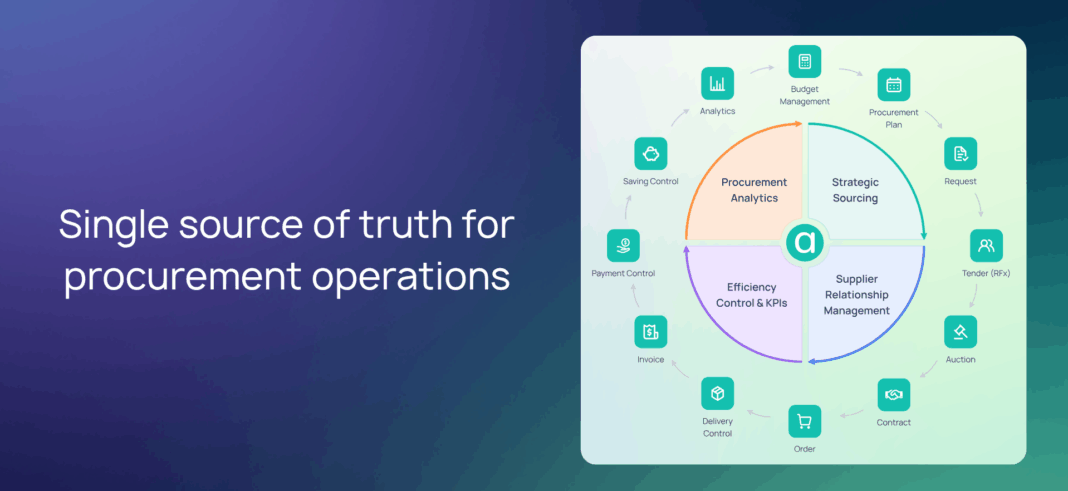
The platform covers the full cycle: procurement planning with live budget validation; structured purchase request intake; tender and auction management; digital contract creation and lifecycle management; order placement with real-time verification against contracted volumes; and consolidated analytics across regions and divisions — all in one system, with no manual handoffs between stages.
The AI Question — and the Honest Answer
Like every enterprise software platform in 2026, APSentra applies artificial intelligence. Unlike many, it is specific about what the AI actually does.
The platform uses AI to study the data that a disciplined, unified procurement environment generates — to surface anomalies, model spend patterns, and flag when something looks wrong before a commitment is finalized. It is not positioned as a replacement for human judgment or as an automation layer that removes people from the process.
That specificity matters because APSentra’s own community polling identified the core reason procurement AI initiatives fail: poor data quality, followed by fragmented workflows and insufficient cross-functional alignment. You cannot build a useful AI application on a foundation of disconnected spreadsheets, inbox-based approvals, and supplier data that lives in three different systems.
“If it’s garbage in, it’s garbage out,” says Sharon Custer, Founder of Inventory Optimization Pro, who has spoken on APSentra’s “Behind Procurement” webinar series. “Building a clean and trusted data foundation is more achievable than ever — but it requires the willingness to confront the underlying mess first.”
The practical implication: organizations that want to get value from AI in procurement need to get their data house in order first. APSentra’s platform is, in part, the infrastructure for doing that.
Proven at Scale Before Entering the Market
APSentra is not a startup arriving in North America to find its first customers. The company enters with a track record that enterprise buyers — particularly those accustomed to long procurement cycles and extensive vendor diligence — will find unusually substantive for a new market entrant.
The platform currently manages more than $129 billion in total procurement spend across more than 130 enterprise clients. It has processed over two million procurement requests and more than 386,000 tenders. It has delivered approximately $16 billion in verified savings. Its customer satisfaction rate sits above 94 percent. Its client base spans financial services, telecommunications, logistics, energy, and infrastructure.
One publicly shared case study describes a large industrial group — operating across manufacturing, infrastructure, and development — that came to APSentra with procurement processes fragmented across multiple business units and entirely disconnected from finance and operations. What the platform delivered was a unified procurement framework across the entire group, with standardized processes, shared governance, and end-to-end supplier traceability. Onboarding efficiency improved materially. Leadership gained a single, reliable view of what was being committed and what was being delivered.
Adam Besson, Chief Executive Officer at FlexChain, frames why that kind of unification matters at the portfolio level: “When a company is running its balance sheet — whether to raise additional funds, make an acquisition, or sell an existing company within a portfolio — it all has to be built on sound financials. If every different team has its own process for self-appraising, that becomes very difficult to do accurately.”
The “Behind Procurement” Series
Alongside its North American expansion, APSentra has launched “Behind Procurement,” a biweekly live webinar series hosted by CEO and Co-Founder Natalie Eksi. The series brings together senior practitioners and industry experts to discuss real-world trends, case studies, and the growing expectation that procurement should function as a strategic finance discipline rather than a purchasing department.
Sessions run every second Thursday at 10 a.m. EST and cover market trends, applied research, and expert perspectives on procurement strategy, financial performance, and AI-driven transformation.
It is, in some ways, an extension of the platform’s core argument: the organizations that are winning are the ones that treat procurement as a business-critical function, not an afterthought. The ones that treat it as an afterthought are, in Eksi’s framing, not running a business so much as making educated guesses.
“In gambling, you hope,” she says. “In business, you control.”
Getting Started
APSentra is headquartered in Mississauga, Ontario, with the platform available immediately to organizations across the US and Canada. Implementation follows a structured five-stage process — consulting, implementation and automation, integration, learning, and ongoing optimization — and typically takes up to eight weeks. The platform is ERP-agnostic and integrates with existing accounting systems, including bidirectional SAP connectivity, so adoption does not require replacing infrastructure already in place.
More information is available at apsentra.com. Upcoming “Behind Procurement” sessions and participation details are available through Natalie Eksi’s LinkedIn profile.


